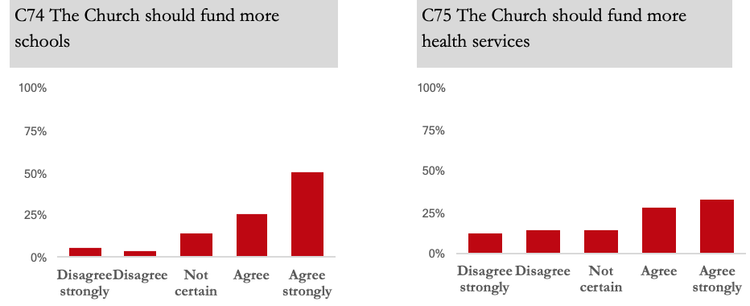
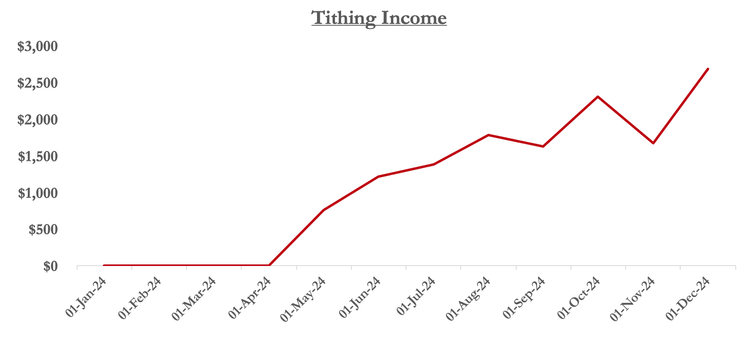
Challenges and OpportunitiesFinancial SustainabilityThe diocese has historically relied on external funding, mainly from the UK. However, as UK church attendance and financial support decline, sustainability has become an urgent priority. Without a strong local financial base, it is difficult to maintain clergy salaries, parish infrastructure, and social outreach programs. Rural parishes, in particular, face economic hardship, making it harder to contribute consistently to diocesan funds. In response, the Masasi Stewardship Strategy is fostering a culture of financial self-reliance. The diocese is rolling out financial education initiatives, creating alternative giving structures suited to rural economies, and strengthening accountability in parish finances. If fully realised, this strategy will not only ensure sustainability but also serve as a model for other dioceses. Engagement with Worship and TraditionWhile worship remains central to diocesan life, generational shifts pose a challenge to maintaining engagement. Many younger congregants express difficulty connecting with traditional liturgy, and some view aspects of worship as overly formal. Ensuring that services remain spiritually enriching for all age groups is essential for long-term growth. To address this, the diocese is strengthening catechetical instruction. Clergy are also engaging directly with younger congregants to explore how worship can remain spiritually fulfilling without compromising its theological depth. Cultural IntegrationHistorically, the UMCA sought to integrate local traditions into Christian life, yet this approach has not always endured. Bishop Lucas attempted to incorporate jando and unyago into Christian rites, but today, many within the diocese prefer to maintain a clear distinction between Anglican sacraments and cultural rites. Survey results show that 70% of respondents disagree with incorporating elements of jando and unyago into Confirmation, and 70% reject the idea that these practices are traditional equivalents of Confirmation. This suggests a strong preference for maintaining a distinct Anglican identity in sacramental practice. Recognizing this, the diocese is focusing on respectful dialogue rather than direct incorporation of cultural rites. While upholding Anglican sacramental theology, clergy are engaging with community elders to ensure that local traditions are understood and respected within a Christian framework. Education and Leadership DevelopmentAs the diocese grows, it must continue developing strong leaders, both ordained and lay, to serve the Church. However, financial constraints threaten the expansion of key institutions, and many congregants lack access to formal theological training. Education remains a top diocesan priority, with 88% of respondents identifying it as a core mission of the Church. However, limited resources make it challenging to expand theological training programs or invest in new schools. Strong Christian values that are central to the diocese boys’ school, Rondo Junior Seminary, and will for St. Catherine’s Girls’ School. Scholarships and sponsorships are being developed to support students in from within the diocese, ensuring a new generation of clergy and lay leaders. HealthcareThe diocese’s historic commitment to healthcare remains crucial, but financial difficulties threaten the sustainability of dispensaries and medical programs. Ensuring continued access to healthcare is vital, especially in rural areas where government services are limited. The diocese is strengthening partnerships with healthcare organisations and seeking new funding sources to sustain and expand its dispensary network. In alignment with the UMCA’s legacy of integrating faith and healing, these efforts will help ensure that the Church continues to serve both the spiritual and physical needs of the community. Social MissionThe Diocese of Masasi has a long history as a local partner for development initiatives and has build up significance experience and expertise. However, this role of local partner has meant that the diocese can only discharge its social mission where they act as agent of international NGOs. The Diocese of Masasi Development Organisation (DMDO) and its WASH+ approach to poverty alleviation aims to discharge the church’s long-established priority to serve the least among us by positioning itself as principal rather than agent, waiting to be chosen to implement time-limited projects at the discretion of other organisations. The DMDO have developed a business model that should position it to make a compelling offer to donors so that it can be a financially self-sufficient department within the diocese that can fulfil the social mission of the diocese. The Value of the Masasi Survey ProjectTo lead effectively within the episcopal tradition, the diocese must understand its congregations. The 2024 Masasi Survey Project has provided invaluable data, offering a clear picture of challenges, strengths, and areas for growth. With this knowledge, Church leadership can make informed decisions that respond to real community needs rather than assumptions. By embracing a data-driven approach, the diocese is taking proactive steps to shape a dynamic, responsive, and sustainable future. The survey will serve as a foundation for long-term strategic planning, ensuring that Masasi remains a thriving centre of faith and service for generations to come. Conclusion: A Modern Diocese Rooted in a Rich HeritageThe UMCA was ultimately absorbed into the United Society for the Propagation of the Gospel (USPG) in 1965, and its direct missionary presence faded. However, its Anglo-Catholic vision continues to shape the Diocese of Masasi, providing a legacy of sacramental worship, education, healthcare, and social mission that still endures today. The diocese stands as a living expression of this heritage, integrating traditional Anglican spirituality with modern realities. As the challenges of financial sustainability, cultural engagement, and leadership development persist, the Diocese of Masasi is responding with dynamic initiatives such as the Masasi Stewardship Strategy and the Masasi Survey Project. These efforts reflect a commitment to self-reliance, pastoral leadership, and informed decision-making, ensuring that the Church remains both historically grounded and future-focused. The survey has provided valuable insights into how the diocese’s congregants experience faith today, allowing leadership to guide them effectively within the episcopal tradition. By embracing these findings, the diocese demonstrates the very spirit of adaptation that defined the UMCA’s mission from the beginning. As we approach the Centenary of the Diocese of Masasi, we celebrate not only our past but also our future. The legacy of the UMCA is not confined to history books—it lives on in our churches, our schools, our dispensaries, and in the faith of our people. In this, the Diocese of Masasi stands as a beacon of the enduring strength of Anglo-Catholic Christianity in Africa. We remain grateful for the prayers and support of our partners. As we continue this journey, we invite all who share in our mission to walk with us. In early January, we will extend invitations to our Centenary celebrations, and we hope you will join us in marking this historic milestone.
|