$$PLAIN_TEXT_PREVIEW$$
Anglican Diocese of Masasi, Tanzania

Tradition and Modern Faith: Navigating Continuity and Change in the Diocese of Masasi

Dear Subscriber First Name,

This is the second of six articles examining the results of the December 2024 Masasi Survey, conducted with 165 participants across 11 parishes. Each article explores how these findings intersect with the lived experiences of Anglicans in this rural Tanzanian diocese, providing insights into faith, leadership, and community life.

The six articles in this series are:

  1. The Diocese in Historical Context

  2. Tradition and Modern Faith: Navigating Continuity and Change (this article)

  3. Episcopal versus Congregational: A Reflection on Church Leadership and Governance

  4. Liberal versus Conservative: Navigating Theology and Practice in the Diocese of Masasi

  5. Attitudes to Finance: Stewardship and Sustainability in the Diocese of Masasi

  6. Faith and Belonging Across Communities.

Introduction

In any church community, faith is a dynamic interplay between inherited traditions and evolving beliefs. For the Diocese of Masasi, this tension reflects broader patterns within global Christianity: how to honour cultural and religious traditions while embracing a faith shaped by modern understandings. Survey responses from congregants reveal a distinct preference for prioritising God over ancestral spirits and adapting traditional practices to align with contemporary Christian theology. This journey, grounded in faith yet open to change, echoes trends seen across the Anglican Communion.

The evolving relationship between tradition and modernity has been well-documented. In an article for the ‘Church Times’, Simon Stubbings highlights how faith practices can evolve in isolation, shaped by local contexts while still connected to global trends. The Diocese of Masasi exemplifies this delicate balance, as it seeks to honour its cultural roots while affirming a Christ-centred faith. By examining survey responses, we can trace how this interplay manifests in the beliefs and practices of Masasi’s congregations.

Responses Reflecting a Modern Faith Perspective

God Over Ancestral Spirits

One of the clearest indicators of a shift toward modern faith is seen in responses to the statements “Praying to God can protect me against evil spirits” and “Praying to God can protect me against curses” compared with “Praying to ancestral spirits can protect me against evil spirits” and “Praying to ancestral spirits can protect me against curses”.  Respondents overwhelmingly agreed with the former statements, emphasising God’s primacy, while expressing scepticism about the protective power of ancestral spirits.

This distinction underscores the diocese’s theological orientation, which prioritises the sovereignty of God and the efficacy of prayer over traditional beliefs rooted in ancestral veneration. While ancestral practices remain culturally significant, Masasi’s congregants appear to view these as secondary to their relationship with God. This aligns with broader Anglican trends, where the Gospel is contextualised but retains its core emphasis on Christ as the centre of faith.

The Role of Traditional Ceremonies

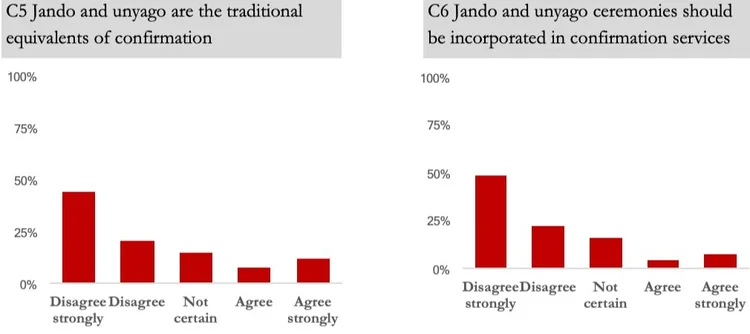
Responses to the statements “Jando and unyago are the traditional equivalents of confirmation” and “Jando and unyago ceremonies should be incorporated into confirmation services” reveal nuanced perspectives. While some respondents recognised the cultural value of these rites of passage, the majority viewed them as distinct from Christian sacraments.

The hesitation to integrate these ceremonies into confirmation reflects a commitment to preserving the theological integrity of Christian rituals. At the same time, there is an acknowledgment that such traditions carry cultural meaning, suggesting opportunities for the Church to engage respectfully with these practices without compromising its doctrinal foundations. This mirrors Stubbings’ observation that isolated communities often adapt traditions in ways that reflect their unique contexts while remaining connected to the broader church.

Theological and Liturgical Adaptations

The survey responses also reveal insights into how tradition and modern faith influence worship practices. For instance, **C60 (“Periods of silence in services help and strengthen my faith”)** and **C63 (“Listening to sermons strengthens my faith”)** reflect a desire for reflective, Christ-focused worship rather than rituals rooted in ancestral veneration.

These preferences highlight the ways in which congregants are embracing a liturgical style that prioritises spiritual depth and theological clarity. Stubbings’ insights on the evolution of isolated traditions resonate here: even as worship practices evolve, they retain a connection to the broader Anglican ethos of sacrament, Word, and prayer.

Tradition and Modern Faith: A Global Perspective

The interplay of tradition and modern faith in the Diocese of Masasi reflects a broader narrative within the Anglican Communion. Historically, the Church has navigated this balance through contextualisation, honouring local cultures while affirming the universality of the Gospel. The Puritans of Massachusetts and the Anglicans of Virginia offer a historical parallel: while both adapted to their contexts, their theological and cultural priorities diverged, shaping distinct identities.

Similarly, Masasi’s congregants are forging an identity that honours their cultural heritage without compromising their commitment to God-centred worship and Christian ethics. This evolution is not without its challenges, but it is also a testament to the adaptability and resilience of faith communities.

Conclusion: Embracing Continuity and Change

The survey responses from the Diocese of Masasi illuminate a faith community that is deeply rooted in its cultural traditions yet oriented toward a modern understanding of Christianity. By prioritising God over ancestral spirits, affirming Christian ethics, and fostering reflective worship, Masasi’s congregants are navigating the delicate interplay between continuity and change.

As Stubbings’ ‘Church Times’ article reminds us, the evolution of religious practices is both inevitable and enriching. For Masasi, this evolution reflects a vibrant, living faith that remains true to its Anglican roots while engaging meaningfully with the world around it. In doing so, the diocese offers a model for how tradition and modern faith can coexist, enriching the life of the Church and its witness to the Gospel.

Have you found this article interesting? Please let us know what you think here.

And please do share this article with friends who might be interested. We you sent this email by a friend? Please subscribe so you can receive articles in this series and other news from our diocese directly.

Diocese of Masasi, Mtandi Street, Masasi, Mtwara, Tanzania

Powered by Squarespace

Unsubscribe